
Adventure Primer
The hook, background, adventure shape, and the problem Branwick Larkspur has accidentally created.
“A goat can ruin your day with a single confident step.”
Old Coast Way saying
This adventure is designed for three to seven characters of levels 3–5 and is optimized for five characters with an average party level (APL) of 3. Characters outside this level range can still be used with encounter adjustments.
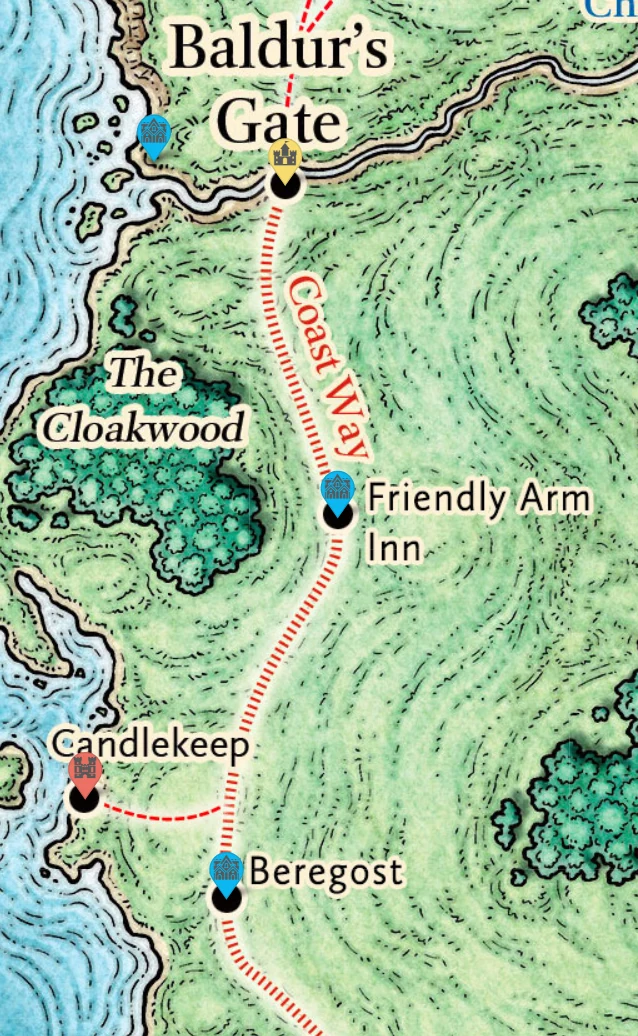
This adventure occurs on the Sword Coast at the Friendly Arm Inn, on the Coast Way between and Baldur’s Gate.
Background
BRANWICK LARKSPUR is a talkative man with more confidence than sense. Weeks ago, Bran discovered a strange artifact. The artifact is an ancient NETHERESE TUNING FORK. Bran found it while exploring a cliffside cave near the Sword Sea where he was grazing his animals.
The fork was already damaged, but Bran broke it when he tried to wrap it up to bring back to his farm. Bran managed to arrive home with only half of it. The other half, the “active” prong, fell into a feed bucket. Bran’s best goat, SIMONE, ate it.
Simone changed within a day. The goat began to flicker in and out of sight, step through fences, and “bring friends” - small creatures that phase in near it as if the goat’s presence drags weak places in the world into brief alignment.
Bran brought the half he had to Baldur’s Gate, where he met in his human guise. Quentin offered to pay for it after he could verify the relic during his next research visit to . Bran received little money up front.
Bran has come to the Friendly Arm almost daily expecting a courier any day with his payment. He brags about his wealth and riches. He fully anticipates life changing amounts of money.
Overview
The adventure has three parts and takes approximately 4 hours to play. The numbered parts match the reader chapters that follow.
Part 1: Prelude & Friendly Arm. The characters meet in the entry line, receive Quentin’s note for Bran, survive the cart catastrophe, follow Bran into the inn, and learn that his missing goat has been changed by the relic he transported. Orren Sable’s ambush follows when the group leaves the walls. Record whether Orren survives, because Adventure 002 uses that result.
Part 2: South of the Cloakwood. The characters track Simone toward the sea cliffs through phased hazards and strange “half-there” creatures drawn to her wake.
Part 3: Got Your Goat. The characters confront Simone on a cliffside pasture above the Sea of Swords while phased creatures blink into the fight around her.
Adventure Hooks
To get the adventure started, you can use any of the following adventure hooks:
The Simple Delivery. Before play, choose one character. A young, thin courier with unruly metallic-bronze hair, crooked round spectacles, a weathered moss-green coat, and a compact delivery satchel pressed a sealed message into that character’s hand and asked them to deliver it to Branwick Larkspur at the Friendly Arm Inn. The meeting lasted only a few breaths. The note is signed with a single initial, “Q.” No one explains who that initial belongs to.
Safe Haven Stop. The party needs a safe night on the Coast Way. The Friendly Arm’s walls, rules, and reputation make it an obvious choice.
Coin and Comfort. A character hears the inn is clean, the food is good, and trouble rarely survives past the gate. They come for rest, not work, which makes the ambush feel personal.
Loose Talk. A character with ties to the Harpers, Flaming Fist, or local merchants has heard rumors of petty theft around the Friendly Arm. Nothing serious. Just enough to keep an ear open.
Prelude & Friendly Arm
Bring the party together at the Friendly Arm, deliver Q’s note, then survive the cart disaster and Orren Sable’s road ambush.
If this adventure is used as the start of the entire series, you can use the following prelude.
1.1 Waukeentide’s End
The Coast Way has been trampled smooth by weeks of constant travel to Baldur’s Gate. Wagon ruts run deep and straight, dust hanging in the air like flour shaken over a board. Evening settles in with a cold edge, the sky bruising from pale blue to copper and violet.
This stretch of road is always busy, but not like this. Packs bulge with cheap souvenirs. Cloaks smell of smoke, spilled ale, and crushed flowers. Faces look satisfied in the particular way people do after spending coin they meant to keep. Everyone is heading south, away from Waterdeep.
Waukeentide has just ended. The banners are down. The last fireworks are ash. The Watch has stopped smiling. Those who made money are guarding it. Those who lost money are pretending they did not. Every road out of the city carries the same spill of humanity back into the Sword Coast.
As the light fades, the Friendly Arm rises ahead. First a hard line against the sky, then stone walls, then lanterns blooming along the parapet. The Coast Way skirts the western wall, feeding into a single gate. A long line stretches toward it. Wagons bunch tight. Oxen snort and stamp. Leather creaks. Foot travelers press together, tired and irritable.
Somewhere inside the walls, you hear a stable bell, the splash of a horse pond, and the low, constant murmur of people deciding whether comfort is worth the price.
The party joins the line outside the gate. They will be waiting several minutes before entry.
Party Introductions
The guards are visible ahead, working with practiced boredom.
- A weapon rack stands just inside the arch, tagged bundles stacked neatly.
- A writing desk sits nearby, a clerk scratching names onto waxed slats.
- A coil of cord hangs from a post.
A guard calls the rules on repeat:
- “Weapons at the gate.”
- “Wizards and priests, thumb to belt.”
- “No brawling. No blood. No fires in the yard.”
Character Entrances.
Bring them in one by one, each arriving at roughly the same time and ending up standing adjacent in the line. Keep introductions brief. Let players notice one another naturally as the line compresses.
The party should clearly register that they are now together and will be treated as such by the guards.
Other NPCs in line.
Use these faces to ground the place. One of them can be recognized later in the Friendly Arm.
- A Calishite spice seller with stained fingers and a small crate that smells like pepper and clove.
- A dwarf teamster arguing with a clerk about whether a hammer counts as a weapon or a tool.
- A halfling pilgrim staring at the gem-decorated shrine inside the walls like it owes her money.
- The Pilgrim Pair. A middle-aged couple in clean, patched cloaks holding hands. They carry a small basket of candles and keep whispering the same prayer under their breath, like a habit that calms them.
- The Loud Merchant. A round man with rings on three fingers arguing about the “insult” of surrendering a dagger. He calls it a “tool.” The guard calls it a “knife.” The merchant loses and mutters about “principles” while tying his coin purse tighter.
- The Fresh Caravan Guard. A young spear-bearer with a shiny helmet and a nervous smile. He keeps practicing a salute that no one returns. He is thrilled to be somewhere that feels safe.
- The Courier. A thin young courier with unruly metallic-bronze hair, crooked round spectacles, ink-stained cuffs, and a weathered moss-green coat beneath a short brown shoulder cape. A compact delivery satchel hangs cross-body. He counts places in line under his breath, loses his count when something catches his eye, and starts again two people ahead.
- The Quiet Priest. A gnome with a tidy beard and a small holy symbol tucked under his shirt. He ties his thumb to his belt without complaint, then nods at the guard like they’ve done this dance before.
- The Wary Old Sailor. Salt-stained coat, rope scars on his hands. He watches the wall, not the gate. He spits once, then decides against it and wipes his mouth like he remembered where he is.
The Reedwhistles Ahead in Line
Ten to fifteen feet ahead of the party stands a small family: the Reedwhistles. Use them to anchor the scene. They are tired, boxed in by packs and elbows, and clearly close to their limit.
Bran Goes Through the Gate
Just before the Reedwhistles reach the gate, a man several places ahead of them finishes his inspection.
This is Branwick Larkspur. Let the party overhear him clearly.
- “Finally,” he says, too loud. “I’ve eaten trail bread for ten days straight. Once I get paid, I’m eating meat again. Real meat. With gravy.”
- “Witnesses, every one of you. I told them I’d be back.”
- The guards wave him through. Bran passes inside the gate and is gone from sight.
Do not delay here. The moment should be brief and memorable.
The Courier
After Bran passes through the gate, the bronze-haired courier approaches the last character in line. He adjusts his slipping spectacles with one ink-stained finger, presses a wax-sealed note into the character’s hand, and speaks quickly, as though the character agreed before he arrived.
“Friend. Excellent. Bran passed through? This is for him. Keep it sealed, please. No questions, no detours. A very simple delivery. Thank you, friend.”
If the character refuses the note: Quentin accepts the refusal without argument. “Of course, friend.” As he turns away, he slips the note into that character’s pocket, pouch, or pack. A character with a passive Wisdom (Perception) score of 15 or higher notices the movement. Otherwise, the character discovers the note later. If caught, Quentin gives an unapologetic nod and says, “Excellent. You have it. Thank you, friend.”
Quentin gives a brisk, satisfied nod, tucks a loose page back into his satchel, and crosses the road. A wagon hides him for a moment. By the time it passes, he has disappeared into the southbound traffic.
1.2 The Cart Catastrophe
Immediately after Bran enters Friendly Arm, the line shuffles forward and stops again.
The bronze-haired scholar disappears behind a horse-drawn cart. The approaching horse pins back its ears, and its eyes roll white.
It rears, then lunges forward. Hooves strike sparks from the road. A wheel clips a stone with a sharp crack, and wood splinters as the cart swings toward the line.
The young family ahead tries to pull back, but people, wagons, and the citadel wall hem them in. The child stares at the oncoming cart as his mother grips his hand.
The horse surges. The cart bears down on them.
Roll initiative.
Give each PC a heartbeat to choose a response. Keep it fast and in initiative order. If they hesitate, the cart closes distance.
Skill Check Examples
Run this as a group challenge: 2 successes before 2 failures. One character may assist another if it makes sense in the fiction.
DC 13 Strength (Athletics)
- Body-check the cart’s rear corner to change its angle.
- Hang onto the side rail and force it away from the line.
- Wrestle the horse’s head aside long enough to break its line.
DC 13 Dexterity (Acrobatics)
- Slip through the crush and yank the child clear.
- Vault onto the moving cart.
- Slide under a flailing harness to reach the reins.
DC 12 Wisdom (Animal Handling)
- Shout, grab the bridle, or get eye-to-eye with the horse.
- Use calm pressure to break its panic long enough to stop the run.
DC 12 Intelligence (Investigation)
- Spot a weak strap, loose pin, or badly tied load.
- Identify the best angle to dump cargo or foul a wheel without crushing someone.
DC 12 Charisma (Intimidation or Persuasion)
- Roar commands that make the crowd break and scatter.
- Snap the horse’s attention with force or confidence.
Creative Examples
Reward smart thinking and quick use of gear.
Gain Advantage: Rope, pack strap, or belt looped around a post, hitch, or cart rail
Remove one failure? Extra action? Pole, spear, or staff jammed into spokes or under the axle; thrown object at the horse’s face or legs
Magic: Resolve the danger first. Guards react immediately after; obvious spellcasting triggers thumb-tie enforcement and questioning once the crisis ends.
OUTCOMES
IF THE PARTY SUCCEEDS
The family is saved and the cart is stopped or diverted. Read the following:
The cart’s weight fights you for a moment, then the wheel catches and drags instead of rolling. The horse tosses its head, but the surge breaks.
You pull the family clear by inches. The child stumbles, then grabs a parent’s coat with both hands like it’s the only real thing in the world.
The cart finally shudders to a stop, angled away from the line. The crowd goes quiet in that stunned way people get right after they almost watched a stranger die.
What happens next
- The gate guard points at the party and the family. “You. Stay where I can see you.”
- The line compresses. The party ends up together in the same pocket of space.
- The family thanks the party, loudly, in front of witnesses.
Reward Options
- The family offers a small pouch of coin or a road snack bundle.
- The guard waves the party forward as a group.
- A bystander buys them a round inside.
IF THE PARTY FAILS
The cart clips the line. People go down. The family is hit unless a last-second save occurs.
Damage and chaos
- Each PC in the impact area makes a DC 12 Dexterity saving throw.
- Fail: 2 (1d4) bludgeoning damage and knocked prone.
- Success: no damage.
- One family member takes a bruising hit and screams.
- The crowd surges.
The cart slams into the edge of the line. Packs spill. Someone hits the ground hard enough to knock the breath out of them.
The mother yells, “KAID!” Her scream is loud and raw. The horse squeals and rears, hooves flashing in lantern light as the driver loses the reins completely.
Shouts fill the air, and the guards push in with hard faces and harder hands.
What happens next
- The guards seize control. A guard drafts the party to help restrain the horse and clear the road.
- The party still gets pulled together, but now the mood is tense and accusing.
Last-second mercy
If you want to avoid the child being harmed, let one PC attempt a final DC 13 Acrobatics check to snatch the child clear as a reaction.
Guard Response
Once the cart stops, a guard steps in to restore order.
- If the party acted heroically, the guard’s tone is clipped but respectful.
- If spells were used, the guard immediately starts the thumb-tie enforcement and demands explanations.
- If the party made it worse, the guard still uses them as labor to clean up.
1.3 Aftermath and Gate Inspection
Once the cart is stopped and order is restored, Sergeant Halden Strake steps in.
Halden has noticed the party acting together, regardless of outcome.
- If they intervened at all, he treats them as a single group.
- If they helped successfully, his tone is clipped but respectful.
If they failed or made things worse, he still groups them together.
Halden completes their gate check as one unit.
- “Weapons at the gate.”
- “Wizards and priests, thumb to belt.”
- “You’re together. Stay together.”
If the party acted during the crisis, Halden makes a small chalk mark on his ledger beside their names. Do not explain this yet.
This mark will later translate to better seating inside the inn.
The party is then allowed to enter the Friendly Arm.
DM Notes on Flow
Do not let Bran linger. His exit creates space for the disaster.
Do not allow the cart scene to start before Bran passes through the gate.
The guards do not stop the party from acting during the crisis.
Halden always notices the party as a group once the dust settles.
This prelude should take 20 to 30 minutes of table time and end with the party entering the Friendly Arm already bound by shared action and public attention.
1.4 From the Gate to the Keep
Intended outcome: get the party through the wall, give them a clear sense of safety, then show the inn as a living place.
Inside the wall, the road dust feels less sharp, like the air itself can relax. The yard opens around you with stables on one side, a small gem-bright shrine on the other, and the keep ahead like a patient stone giant. The smell of veal in caper cream drifts from a shuttered kitchen window, and someone inside laughs like they have never been hungry.
Setting
Left to right. To the left, stables and a horse pond sit behind a waist-high fence. A stable hand leads a mare to water. To the right, the Shrine of the Short squats low, its interior walls catching light from embedded nuggets and cut stones. Ahead, a stone path leads to the keep’s arched entry and heavy doors.
Security. Two guards stand at the keep’s entry. They are relaxed but not friendly. If characters try to draw weapons or cast obvious spells, the guards intervene fast and without debate.
Bran’s behavior. Bran does not go far once inside. He wants witnesses. He wants to be seen. He scans the yard, spots the keep’s door, then moves with purpose like he has rehearsed the walk.
If the Party Explores the Yard
Do not force the party directly into the inn. The temple and stables provide short scenes that reward investigation and point back to Bran. Keep Bran inside the common room unless the party avoids the inn for more than ten minutes. He then returns to the yard and loudly asks whether anyone has received a letter for him. Run the delivery scene wherever the party meets him.
The Temple of Wisdom
The gem-lined building travelers call the Shrine of the Short is the Friendly Arm’s Temple of Wisdom. is inside checking lamps, straightening offerings, and tending anyone hurt during the cart accident.
Gellana answers reasonable questions but will not open or read a sealed letter addressed to someone else. If shown the note, she recognizes Bran’s name and points toward the keep.
- Bran visits almost every day and loudly tells anyone nearby that a courier will bring his payment.
- Gellana saw Bran enter the common room moments ago.
- She noticed the bronze-haired courier outside the gate but lost sight of him when the cart crossed between them.
Gellana offers basic treatment for injuries from the cart accident. If the characters want a longer theological discussion or service, she asks them to return after they finish their delivery.
The Stables and the Spooked Horse
The draft horse from the cart accident is now inside the stable yard. A stable hand walks it beside the pond while another checks its legs and harness. The horse is scraped and trembling but has no serious injury. It pins its ears and pulls away from bronze-colored objects, flapping cloaks, or anyone who approaches too quickly.
A character who succeeds on a DC 12 Wisdom (Animal Handling) check calms the horse enough to examine it. On a failure, the horse retreats behind the stable hand but does not attack. The stable workers know only that it panicked as the bronze-haired courier crossed in front of the cart.
If a character magically speaks with the horse and asks what frightened it: Make the cause clear. The horse saw the courier change shape. It describes the event in blunt images: “The little bronze-haired man became huge. Hard bronze hide. Great wings. The air tasted like a storm. Then he was above me and gone.” The horse was spooked by Quentin changing from his human guise into his true bronze dragon form and taking flight. It does not know Quentin’s name or where he went.
If the Party Goes Somewhere Else
Other doors lead to private rooms, storage, kitchens, guard spaces, or settlement work areas. Staff politely redirect visitors to the common room. If the party persists, Halden tells them that Bran is inside waiting for a courier. Do not add another encounter or hide the next scene behind a check.
1.5 The Friendly Arm Inn
Intended outcome: place Bran where he can be overheard, give the party a chance to deliver the note, and let the thieves set their plan.
The keep’s common room is warm and loud. A long hearth throws heat across worn stone, and the air tastes like roast veal, fresh bread, and spilled ale. Light falls in dusty beams from high windows, catching drifting smoke from pipes and candles. Travelers lean close over cups, guards sit with their backs to walls, and servers move like they have done this a thousand times.
Setting
High windows line the left wall, their sills stacked with empty mugs waiting for collection. The hearth dominates the center wall, with benches angled to steal its warmth. To the right, the bar runs long and polished, backed by shelves of bottles and a narrow stair that leads up to rooms. The floor is scarred wood, swept clean but never truly free of old stains. Bentley Mirrorshade is the Innkeeper.
Patrons not in line.
- A pair of Flaming Fist mercenaries playing dice, speaking low.
- A merchant with ink-stained cuffs counting coins twice.
- A gnome priest from the nearby shrine arguing cheerfully about “proper laughter” with anyone who will listen.
- A tired bard plucking a lute with three strings, taking requests they cannot play.
Where Bran sits. Bran claims a two-top table near the hearth, angled so he can see the door and the bar at the same time. His bright scarf hangs over the chair like a flag. He places his satchel on the table with deliberate care, then taps it once like it contains destiny.
1.6 Delivering the Note
The party makes contact with Bran, the note lands, and Bran’s humiliation becomes the spark that pulls everyone outside the walls.
If the characters hesitate to approach, Bran notices them watching and invites them over with a loud wave. He wants an audience.
The Note (Handout Text)
Give the exact text below to the player chosen for the delivery, or read it aloud if needed.
Dear Friend,
Thank you for the effort. Truly. You have saved me time, which is more precious than coin, and coin is already quite precious. Sadly, what you delivered is not what I expected. It is incomplete, and in its current state it does not serve my purposes.
I do hope you are safe. I would dislike losing a useful friend over a misunderstanding.
Warm regards,
Q
If the Note Does Not Reach Bran
Do not let a missing prop stall the adventure.
- Dropped: Someone in the gate line spots the sealed paper. If the party does not recover it, Halden sees Bran’s name on the outside and has a guard carry it to him in the common room.
- Lost or destroyed: Halden or another gate guard saw the bronze-haired courier approach the party. When Bran starts asking about his expected payment, the guard points him toward them. Bran demands an account of the encounter and any words they remember.
- Nothing remains and no one read it: Bran takes the missing payment and the courier’s attempted delivery as proof that Q rejected the incomplete artifact. He reacts as described below and, under pressure, admits what was missing and what happened to Simone. The hook continues without the physical note.
If the Party Breaks the Seal
Bran thinks they are lying. This is true even if the characters repeat the message exactly. If they admit reading it, he assumes they omitted or altered something important. If they deny it, he points to the broken wax and accuses them of lying about opening a private message. Do not let one Persuasion check erase his suspicion. Bran still needs their help, so he reveals the same information, but he remains defensive and treats them as unreliable until their actions prove otherwise.
Bran’s Reaction
Bran reads the note once. Then again, slower. His smile becomes a tight line. He looks up, eyes bright with anger and embarrassment.
Bran does not accuse the messenger. Bran accuses the universe.
Use any of these lines, aimed at the room as much as the party:
- “A ‘misunderstanding.’ That is what people call theft when they want it to sound polite.”
- “Incomplete. Incomplete. I nearly died for ‘incomplete.’”
- “Friend. I do not recall sharing a meal, a joke, or a single sincere moment with a letter.”
Bran then lowers his voice and speaks directly to the party.
What Bran tells them (plain language)
- He found a strange artifact near the coast one day.
- It seemed ancient, and a passing scholar returning to was interested. He gave it to the scholar and has been expecting payment since.
- The artifact was in two parts: a base and a humming crystal.
- He expected coin. He got a letter.
What Bran leaves out (until pressed)
- He gave the scholar only one part and a “rock” for the other.
- The other part was taken by “Simone”. He will say stolen by Simone.
- Simone is a goat. Embarrassed, he won’t reveal that Simone is a goat or that Simone ate the “crystal” and then vanished shortly thereafter
- He doesn’t know exactly where Simone is.
If the Party Presses for Details
If the characters press with Insight, intimidation, or simple persistence, Bran admits the truth in fragments.
- “It fell. Into feed. It was an accident.”
- “Simone eats anything. Anything.”
- “Then the fences stopped being a problem.”
If the party reacts badly, Bran pivots to wounded pride. He insists he can fix it. He just needs help and witnesses.
If the Party Tries to Start a Fight Inside the Walls
Some groups will decide the letter is a trap, the inn is compromised, or Bran is lying.
The guards intervene at the first drawn blade.
If spells fly, Halden Strake and two guards rush in and demand surrender.
If the party persists, they are escorted out and told not to return.
If that happens, move the delivery scene outside the walls near the weapon racks. Bran still needs witnesses. The ambush still happens.
1.7 Beyond the Walls
Intended outcome: Bran convinces the party to walk with him to his farm, the party retrieves weapons, and the thieves choose a clean spot to strike.
Bran insists on leaving now.
“If I sit, I stew.”
“If I stew, I shout.”
“If I shout, someone sells my story with extra lies.”
Bran leads them back to the gate. He retrieves his weapon with shaking hands, then does not draw it. He wants to look brave, not be brave.
If the party wants to involve the guards: Halden Strake listens and shrugs. This is “outside the wall” business. He offers one piece of advice: “Don’t bring trouble back to my gate.”
If the party refuses to go: Bran offers a cut of his expected payment, then admits there is no payment yet. If they still refuse, Bran goes anyway, and the ambush targets him alone. The party can choose to intervene or chase.
1.8 Ambush on the Farm Road
Intended outcome: the party fights together in a clear, outdoor skirmish. The ambush points at a bigger problem without explaining it yet.
You leave the Friendly Arm behind, the wall shrinking at your back. The road turns to a packed dirt lane that runs between low hedges and open grass. The air tastes of salt and seaweed, and gulls cry somewhere beyond the cliffs. Ahead, a shadow peels away from the hedge line, then another, then four more, like the road itself has decided you have walked far enough.
Setting
To the left, a hedge runs thick with thorns, broken in one place where boots have crushed a path through it. Beyond lies a shallow ditch and a slope down to scrub grass. To the right, a split-rail fence holds in a small pasture dotted with pale stones. Farther right, the land rises toward the keep’s wall.
Cover and terrain.
The hedges grant half cover and block sight through them.
The ditch is difficult terrain.
The fence can be vaulted with a DC 10 Strength (Athletics) check or climbed with DC 10 Dexterity (Acrobatics).
Visibility. Clear daylight. The keep’s wall is visible behind the party. A guard patrol can hear sustained fighting, especially if the party retreats toward the gate or calls for help.
Optional Friendly Arm Guard Intervention
The guards are not required to save Orren, and Orren’s survival is not required for the series. Use this option if the fight remains close enough to the walls and preserving him as a recurring rival would improve continuity.
- At the end of round 3, or when Orren is first reduced below half his hit points, the party sees two Friendly Arm guards running from the gate. Their shouted command gives every combatant a full round to react.
- If Orren is reduced to 0 hit points after the patrol is visible, a guard can stabilize him with a healer’s kit once the immediate threat is controlled. This does not undo disintegration, decapitation, a fall from the cliff, or another clearly unrecoverable death.
- The patrol demands surrender and prioritizes stopping bloodshed. It does not automatically side with the party and will take surviving bandits into custody if it wins control of the field.
- If the party objects, flees, or finishes Orren before the patrol can reach him, let that choice stand.
Creatures
Captain Orren Sable set this ambush after his lookout heard Bran talk about a “reward” and saw the courier note arrive.
Use the following enemies:
1 bandit captain (Orren Sable)
1 scout (Mara Drennen)
4-6 bandits (road crew)
Enemy Tactics
Mara opens from range and tries to drop a backline caster or healer first. If threatened, she disengages into the hedge break, then reappears from a new angle.
Orren stays calm. He orders the party to hand over “the payment” like it is a toll. If refused, he focuses on the character closest to Bran to make a point.
The bandits try to surround one target at a time. They shove creatures into the ditch if they can.
If the fight goes poorly for the thieves, Orren calls for a retreat toward the hedge break. Mara covers the retreat. Orren’s goal is survival, but the dice and the party’s choices can still kill him.
What the Thieves Say
Use any of these lines to make the motives plain:
Orren: “Neighbor, don’t make this loud. Hand over what the letter promised.”
Mara: “He’s got coin. He was bragging about all the coin he was going to get.”
Bandit: “We heard ‘reward.’ We like rewards.”
If the Characters Try to Talk
- Orren will negotiate for one round.
- He offers to “leave them half” if they hand it over.
- He asks Bran to step forward and “settle it like friends.”
- Bran refuses. Loudly. He wants witnesses.
- If the party offers coin to avoid combat, Orren takes it and still tries to take Bran’s satchel unless the party makes it clear they will fight.
Treasure
On Orren or the bandits, the characters can find:
- 35 gp and 120 sp from earlier thefts.
- Orren’s simple silver earring, shaped like a crescent hook.
- Mara’s scrap of paper, bearing the line “Rich man. Bright scarf. Payday.” in neat handwriting.
After the Ambush
Record Orren Sable’s Fate
- Survived and escaped: Orren can follow the party into the sea cave in Adventure 002.
- Survived in custody: the Friendly Arm guards take him alive, but his crew bribes a handler, intercepts the transfer, or helps him escape before Adventure 002. Because Orren survived, the later pursuit remains active.
- Died: Orren is dead. Adventure 002 has no pursuers and no replacement rival. Its Wreck Hall becomes a direct confrontation with the chuul.
Bran is shaken, furious, and grateful in the way proud people get when they hate needing help. He wants to leave the road and reach his farm fast.
End this section with Bran’s push forward:
“They think I have coin. I have a problem. Come. I will show you the problem. Then we make someone regret writing letters with one smug little initial.”
South of the Cloakwood
Follow an unreliable phase trail along the Cloakwood fringe toward the cliffs above the Sea of Swords.
Estimated Duration: 45 minutes
This part is a short travel sequence with 2-3 scenes (pick as needed). Each scene points the party toward Simone, the phase goat, and reinforces that something in the landscape is slipping out of place.
Quick Table of Contents
2.1 The Bleat That Isn’t There (exploration)
2.2 The Belt-Tied Pilgrim (social)
2.3 The Tree That Remembers Wrong (hazard)
2.4 Phased Pack at the Game Trail (combat)
2.5 The Tidepool That Breathes (treasure)
2.6 The Unexpected Encounter: The Cliffside Slip (combat + hazard)
South of the Cloakwood
The party leaves the Coastway and Friendly Arm behind them and heads west toward the Sea of Swords. They pass near the southern edge of the Cloakwood. The air grows wet and resinous. Pine and darkleaf press close to the road. The Sea of Swords is still out of sight, yet salt rides the wind in thin gusts.
Reality has begun to fray along this route. Small animals and insects appear in the wrong places, then vanish. Sounds arrive late, as if the world is thinking about them first.
Story Objective: Reach Simone’s pasture near the Sea of Swords
Confirm the direction: the party must leave the Coast Way and follow a rough track toward the cliffs.
Show the threat: phased creatures test the party’s readiness.
Seed the pattern: “phase-thinning” grows worse the closer they get to Simone.
Running This Part
Pick two entries if your table is moving fast. Pick three if you want a fuller travel leg. Use 2.6 as your capstone scene for this part if you want a clear spike before the cliff pasture.
2.1 The Bleat That Isn’t There
This scene is meant to pull the party off the main road and onto the rougher track toward the cliffs. It gives a clean, physical trail to follow.
A thin stand of pines leans over the road, needles slick with mist. To your right, the woods deepen into black-green shade. To your left, low scrub and pale grass run toward unseen sea cliffs.
Bran turns, “Simone and I followed this path. Leads to the cliffs of the Sea of Swords.”
One of you hears the faint jangle of a bell from somewhere ahead. The sound stops before anyone else can turn toward it.
Setting
Right: Cloakwood edge. Tangled roots, dark undergrowth, spiderwebs that glint like wire.
Center: A narrow game trail splits off the road, pressed down by repeated hooves.
Left: A shallow slope of scrub grass. The wind is stronger there. It carries salt and a faint, metallic tang.
Checks and Clues
- DC 13 Wisdom (Survival): The hoofprints are fresh. They drift in and out of the soil’s surface, as if the weight that made them was not fully present.
- DC 14 Intelligence (Arcana): The trail has a weak planar “stutter.” It feels like a badly tied knot in the Weave.
- DC 12 Wisdom (Perception): A few tufts of pale hair snagged on thornbushes. The hair is dry, even in the mist.
If the Party Stays on the Coast Way
They hear the bleat again in 10 minutes, closer, then farther. They lose time. A light combat scene from 2.4 finds them on the road instead of the trail.
Leads Toward Simone
Following the hoofprints for 15-20 minutes puts the party on the correct westward track toward the pasture.
2.2 The Belt-Tied Pilgrim
This scene is meant to give the party a friendly voice and a strong directional pointer, plus a rumor that makes Simone feel real.
A lone traveler stands by the roadside where the trees thin, looking west as though he expects the horizon to answer. He wears a sun-faded cloak that smells of smoke and cheap soap. A short cord moves through his fingers as he ties and loosens the same knot. When he notices you, his face relaxes with relief.
Creature Information: Rilsa “Rill” Harrowmere uses the . He is skittish, quick to talk, and eager to be helpful.
Social Play
If the party is kind, Rill shares what he knows and points them to the west track.
If the party threatens him, he bolts into the brush and later becomes a frightened witness at the edge of the cliffs.
Leads Toward Simone
Rill can point to a visible landmark: “A split boulder like a broken tooth. The track turns there, then you smell the sea.”
2.3 The Tree That Remembers Wrong
This scene is meant to show the “phase” problem without combat. It should feel off and mildly funny until it turns unsettling.
A broad oak rises from the edge of the trail, its trunk thick and weathered, the bark carved with overlapping initials from many different hands and many different years. To your left, its roots heave up through the soil, bending the earth as if something beneath were clenching a fist.
The branches above spread into a heavy canopy that should cast deep shade, yet the shadows beneath it fall at odd angles, not quite lining up with the leaves overhead. Sunlight slips through where there should be none, while darker patches linger where the light should reach.
“I do not remember that tree being here.” Bran looks confused. He places his hand to the chin. “I’ve been on this path hundreds of times.”
What the Tree Actually Is
In the Feywild, there exist memory-anchored trees that do not record events as they happened, but as they were felt. They are planted at sites of emotional convergence. Regret, promises broken, joy cut short, or stories retold too many times.
This oak is one of those trees, and it was phased here because of Simone.
Instead of anchoring memory to place, it anchors place to memory. When pulled partially into the Material Plane, the result is spatial hesitation. Reality checks itself, realizes something is wrong, then resumes half a heartbeat later in the wrong spot.
Skill Checks
- DC 12 Intelligence (Nature): This oak is not native to the Sword Coast. Its growth pattern, root structure, and canopy behavior suggest an environment where seasons and sunlight do not behave consistently.
- DC 16 Intelligence (Nature): The tree’s roots are not responding to the surrounding soil correctly. It is sustaining itself as if the land were something else entirely, forcing the ground to adapt around it rather than the other way around.
- DC 13 Intelligence (Arcana): There is a subtle planar distortion around the tree. Space feels slightly compressed and uneven, as though the area has been folded and unfolded more than once.
- DC 17 Intelligence (Arcana): The distortion resembles imperfect overlap with another plane. Whatever crossed over here did so incompletely, leaving behind a lingering instability.
- DC 14 Wisdom (Perception): For a brief moment, a character notices something unsettling. A shadow shifts twice when nothing moves, or a root seems to be underfoot no matter where they step.
- DC 15 Wisdom (Insight): The tree is not hostile, but it is not passive either. It feels confused, as if it is trying to reconcile where it is with where it believes it should be.
The Goat Bell (Why This Matters)
The broken bell is not random. The tree remembers a goat. At some point in the recent past, when the tree crossed planes, it tried to bring that memory with it.
The bell is cold because the memory is incomplete.
It smells of sea salt because the story ended near water.
How to Play the Tree Without Explaining It
Never explain the tree’s function in-world unless the party forces the issue with magic or extraplanar knowledge.
Let them notice patterns instead:
- The same root seems to be underfoot no matter where they step.
- Shadows lag behind movement by a fraction of a second.
- Someone swears they see themselves standing where they were a moment ago.
If a character familiar with the Feywild studies the tree long enough, give them this realization, and nothing more:
“This tree knows me. It just doesn’t remember me correctly.”
That line will carry farther than any exposition.
2.4 Phased Pack
This scene is meant to be the medium combat encounter for the travel leg. It reinforces that Simone is not alone. The pack fights like it is being “pulled” in and out of place.
The trail narrows between brambles. To the left, the trees crowd close, their trunks dark with wet moss. To the right, the land slopes down into scrub that shivers under a hard sea wind. A low growl starts behind you, then from ahead, then from the brush to your side, as if the sound can’t decide where to live. The air tastes metallic, like old coins.
Creatures
Choose one set based on party strength.
Default (APL 3, medium): 4 (with teleport):
Teleport (Recharge 4–6). The dog teleports up to 40 feet to an unoccupied space it can see.
Enemy Tactics
The pack fights in short bursts. The creatures have been altered by the phase disturbance and can teleport.
Terrain
Left (trees): Half cover from trunks and roots.
Center (trail): Difficult terrain from brambles if a creature leaves the path.
Right (slope): A creature that takes damage while standing on the slope must succeed on a DC 12 Dexterity saving throw or slide 10 feet downslope.
2.5 The Tidepool
This scene is meant to give the party a small reward and a clear “the sea is close” signal. It also lets you show strange physics without a fight.
The trees break apart and the wind turns hard. To your left, the last line of Cloakwood pines bends away from the coast, needles hissing. Ahead and to the south, pale rock juts from the earth in low shelves. In a bowl of stone, a tidepool sits far above the beach line, its water rising and falling as if it has lungs. The smell is salt, kelp, and cold stone after rain.
Setting
Left: Thin trees, exposed roots, patches of webbing.
Center: Stone shelves with slick edges.
Right: Drop-off begins to hint at cliffs ahead.
Checks and Rewards
- DC 13 Intelligence (Investigation): Something is lodged under the water that should not be there.
Reaching into the pool requires a DC 12 Dexterity (Acrobatics) check to avoid slipping on algae-slick stone.
Treasure: A palm-sized shard of dark, glassy metal etched with tiny, worn sigils.
Cursed Luckstone
Wondrous Item, uncommon (requires attunement)
This flat, gray-and-black river stone is inscribed with an unknown arcane symbol and feels cool to the touch. While carrying the stone, you can gain advantage on one ability check of your choice. The stone can’t be used this way again until the next dawn.
Curse. This item is cursed. Attuning to it curses you until you are targeted by a remove curse spell or similar magic. As long as you remain cursed, you cannot discard the stone, which immediately teleports back into your pocket or pack. After you use the stone’s magic, your next two ability checks are made with disadvantage.
2.6 The Cliffside Slip
This is meant to be the surprise spike. It should feel like the landscape itself is hostile for a moment, and it should end with a clean line of travel to the pasture.
The path climbs onto broken stone. To your left, the last trees cling to cracks, their branches scraping and clicking in the wind. Ahead, the ground opens into pale rock that drops away in jagged steps. To your right, there is nothing but salt spray and distance, and the Sea of Swords roars far below.
Then the world lurches. For a heartbeat, the cliff face is somewhere else, and your stomach tries to follow it.
Hazard: The Skip
At the start of each round, roll 1d6.
| d6 | Result |
|---|---|
| 1–2 | No effect. |
| 3–4 | One creature skips. Choose one creature at random. It must succeed on a DC 14 Dexterity saving throw or teleport 10 feet to a safe space of the DM’s choice and fall prone. |
| 5–6 | The ledge tilts. Each creature on the cliff path must succeed on a DC 13 Strength (Athletics) check or slide 15 feet toward the edge. |
DM Options
If your party hates cliff danger, move the “edge” threat to a steep scree slope that bruises and slows instead of dropping to death.
If your party loves cliff danger, let a failed slide carry a creature to the lip, hanging by one hand, requiring an action to recover.
Tracking Simone
Use this section any time the party is trying to find Simone’s trail, confirm they are still going the right way, or locate the cliff pasture. It is written to support ranger-style play without requiring a ranger in the party.
Intended Outcome: The party should feel like they are actively hunting a moving problem. Successful choices shorten travel and give advantages in the upcoming fights. Failure costs time and resources but still moves the story forward.
The Trail at a Glance
Simone’s trail is unreliable in normal ways (wind, rain, rock) and unreliable in unnatural ways (prints that “skip,” sounds that arrive late, animals that appear where they should not be). The closer the party gets to the cliffs, the more the unnatural signs dominate.
Common signs of Simone
- Hoofprints that end mid-step, then resume several feet away.
- Tufts of pale hair snagged on thorns and fence wire.
- A faint bell chime that seems to come from the wrong direction.
- A metallic tang in the air, like old coins or struck iron.
- Small animals acting wrong: rabbits freezing, birds landing without sound.
Who Can Lead the Search
Any character can do this. Use whichever skill fits their approach.
Wisdom (Survival): Tracking, route choice, reading weather and ground.
Wisdom (Perception): Spotting trail signs, hearing the bell, noticing phase flickers.
Intelligence (Investigation): Pattern recognition, reading broken fences, predicting where Simone went.
Intelligence (Arcana): Sensing planar thinning, identifying “skip zones,” choosing safer routes.
Wisdom (Animal Handling): Interpreting animal behavior, calming mounts, predicting a goat’s habits.
Ranger features: If a ranger is present, let their features shine (especially foraging, tracking, difficult terrain, and favored terrain). If not, these rules still work.
Running the Search
Pick one method based on pacing.
Method A: Simple Navigation Checks (fast)
Use this when you want to keep the travel moving.
- One character makes a DC 14 Wisdom (Survival) check once per travel segment (about 15 to 20 minutes of table time).
- On a success, they gain a benefit from the Success Benefits list.
- On a failure, apply a Complication.
Method B: Three-Step Tracking Challenge (ranger-friendly)
Use this when the party is leaning into the hunt.
Goal: 3 successes before 2 failures.
DC: 14 (raise to 15 if the party is moving at speed or it’s raining).
Each step, a different character can contribute using a different skill. Encourage variety.
Step prompts
- Find the trail. Locate signs that Simone passed recently.
- Keep the trail. Prevent losing it when the ground turns to rock or brush.
- Predict the cut west. Identify the best approach to the cliff pasture.
Success: They reach the pasture cleanly and gain one major benefit.
Failure: They still reach the pasture, but with time lost and one added threat.
Success Benefits
Use these to reward good play without breaking the adventure.
Time Gained: They arrive sooner. The party can take a short rest before the next encounter.
Clean Approach: They choose the best route and avoid a hazard. Ignore one travel event or skip a minor encounter.
Read the Skip: The lead tracker spots a phase-thin zone. The party gains advantage on the first saving throw against a “skip” effect during Part 3, “Got Your Goat.”
Better Position: In the next combat, the party chooses the battlefield side and starting spacing.
Trail Token: They recover something that confirms they are close:
- a tuft of Simone’s hair that crackles faintly in the wind
- a broken bell strap
- a hoofprint burned into stone like a brand
Complications (pick one per failure)
These keep momentum but add pressure.
Lost Time: Travel takes longer. The party cannot take a short rest before the next encounter.
Wrong Turn: They hit an unpleasant patch of terrain. Each character makes a DC 12 Dexterity saving throw or takes 1d6 bludgeoning damage from slips, thorns, and hard falls.
Cold Trail: They lose Simone’s direction for 10 minutes. The next tracking check is made at disadvantage unless they change approach or spend resources.
Draw Attention: A phased creature notices them. Add a quick skirmish or increase the next ambush by one creature.
Bad Ground: The party’s mounts or pack animals become skittish. Everyone has disadvantage on Animal Handling checks until they calm them.
Simone’s “Phase Echo” Rule
As the party gets closer to Simone, the trail becomes less physical and more sensory. When the party is within about an hour of the cliffs, introduce this rule:
Phase Echo. If a character succeeds on a tracking-related check by 5 or more, they catch a brief “echo” of Simone:
- a bell chime one ridge over
- the smell of goat and wet grass on a wind gust that stops too fast
- a silhouette on a rock ledge that vanishes when blinked at
This echo always points them toward the cliff pasture. It never sends them away.
Clever Player Options
If the party tries one of these, reward them with advantage or an automatic success.
Bait and bell: If they have a goat bell, they can ring it. Simone’s echo answers once within 5 minutes.
Salt lure: If they scatter salt or mineral lick, Simone’s hoofprints appear in the dust within 10 minutes (even if she isn’t physically there yet).
Speak with animals: Animals don’t know “Netherese artifact,” but they know “the goat that vanishes.” They point west and act nervous when the cliffs are mentioned.
Detect magic: Reveals a faint transmutation aura that grows stronger toward the cliffs. This gives advantage on the next navigation check.
Mark the trail: Chalking stones or tying cloth strips prevents the “looping road” effect. It cancels one disorientation hazard.
If the Party Does Something Unexpected
They try to capture Simone early: They cannot. Simone is already beyond the trail segment, and the echoes pull toward the cliff pasture. Let them get close enough to see a flicker, then it’s gone.
They go deep into the Cloakwood instead of west: The forest becomes darker and webbed. Give them one warning event, then steer them back with a clear sign (a hoofprint on a tree root, a bell chime from the west).
They attempt to return to the Friendly Arm: They can, but the trail grows colder. If they return, increase the difficulty of the next tracking check by 1 and add a complication from “Draw Attention.”
DM Cheat Sheet
If you want to run this with minimal thought at the table:
Every 15 to 20 minutes of travel, ask: “Who leads the search?”
Roll one check: DC 14 Wisdom (Survival). Success: pick one Success Benefit. Failure: pick one Complication.
Always end the segment with a concrete sign pointing west toward the cliffs.
This keeps the hunt active, rewards smart play, and guarantees the party reaches Simone’s pasture on time.
Got Your Goat
Confront Simone on the cliff pasture and force the three-step Netherese resonance to burn itself out.
Estimated Duration: 60 minutes
The characters confront Simone on a cliffside pasture above the Sea of Swords as phased creatures blink into the fight around her.
Intended Outcome
This part is meant to end the chase and turn Simone into a memorable set-piece fight. The party reaches the cliff pasture, survives a shifting battlefield, drains the Netherese resonance inside Simone, recovers the broken Netherese artifact, and watches Simone return to being an ordinary goat.
Scenes
3.1 Approach to the Cliff Pasture (exploration)
3.2 The Pasture on the Edge (exploration + hazard)
3.3 Boss Encounter: Simone, Phase Goat (combat)
3.4 Aftermath: The Relic Burns Out (resolution)
3.1 Approach to the Cliff Pasture
This scene is meant to put the party on high ground, let them smell the sea, and give them a clear view of the pasture. It should also show that Simone is close, even when she is not visible.
The trees thin and the wind hardens. To the left, the last line of Cloakwood pines clings to damp earth, their needles hissing. Ahead, pale rock rises in broken steps, slick in places where mist beads on stone. To the right, the land drops away into open air, and the Sea of Swords roars far below like a steady drum.
A goat bell rings once, bright and wrong for this distance. A second later the sound arrives again, softer, like an echo that forgot to follow rules. You smell warm animal hair and crushed grass on a gust that stops too suddenly.
Setting
Describe the approach from left to right, top to bottom:
Left: ragged treeline, low brambles, and a shallow cut where rainwater runs toward the rocks. Webbing clings to a few branches like thin lace.
Center: a broken path of pale stone steps leading uphill. Loose gravel collects in the seams.
Right: open cliff air and a sloping shelf of rock that leads toward the pasture. The shelf is wide enough for two travelers shoulder to shoulder, no more.
Checks and Clues
- DC 14 Wisdom (Survival): Fresh hoofprints appear on bare stone as scuffed patches of grit. They stop mid-step and resume several feet away.
- DC 14 Wisdom (Perception): The bell sound always seems to come from slightly uphill and slightly west, even when it should not.
- DC 15 Intelligence (Arcana): The air carries a faint transmutation pulse, strongest whenever the bell rings.
If the Party Tries to Scout from Afar
They can see the pasture fence line and a low shepherd hut. They cannot reliably see Simone. If she appears, it is for a breath, then she is gone.
A character who watches through a spyglass sees two Simones for a moment, one half a step behind the other.
If the Party Turns Back
The bell rings from behind them once. The smell of goat vanishes. The trail grows colder fast. Use this as a gentle push to continue uphill.
3.2 The Pasture on the Edge
This scene is meant to establish the battlefield before initiative. Give the players a moment to choose a plan, then let Simone's presence start the weirdness.
The pasture sits on a shelf of grass and stone, fenced with weathered rails that lean away from the sea wind. To the left, a low shepherd hut squats against the slope, its roof patched with tar and driftwood. Ahead, the grass ripples in uneven waves, greener in some strips, pale and brittle in others, as if the ground cannot agree on the season. To the right, the fence line ends at a natural break where rock drops to open air. Salt spray rises in a faint veil.
You hear hooves on stone, then on grass, then nowhere. The bell rings again, and for a heartbeat you see a white goat standing near a boulder, head down, chewing like nothing in the world could be urgent. Then she is not there.
Battlefield Features
Left: Shepherd hut (10 feet by 15 feet). The door hangs crooked. The hut smells of old hay, tar, and mouse droppings. Inside are a broken stool, a clay jug, and a rusted lantern.
Center-left: A salt lick stone on a stump. The stump is scored with bite marks. A character who scatters extra salt here can draw Simone's attention for one round.
Center: A flat boulder the size of a wagon bed. It provides full cover to a Medium creature crouched behind it. The bell sound often seems to come from its far side.
Center-right: A shallow water trough half-filled with rain. The water surface sometimes ripples upward, like it is pushed from below.
Right: The cliff break and a sloping rock shelf. Strong wind pulls at cloaks. The air smells of salt and wet stone.
Hazards
Sea Wind Gusts: At the start of each round during combat, choose one creature within 10 feet of the cliff break. It must succeed on a DC 13 Strength saving throw or be pushed 10 feet toward the safest open space (never directly off the cliff unless it is already at the lip).
Loose Gravel: A creature that dashes across the rock shelf must succeed on a DC 12 Dexterity saving throw or fall prone.
Cliff Edge: The edge is visible but deceptive. The grass near it grows thin and slick. A creature pushed to the lip can catch itself with a DC 14 Dexterity saving throw, ending prone and hanging.
What Simone Is Doing When the Party Arrives
Simone is oblivious. If she is visible, she is chewing grass, scratching her shoulder on the fence, or staring at a gull as if it has offended her.
She does not posture. She does not flee like prey. When startled, she headbutts first and thinks later.
The closer someone gets, the more the air stutters around her. The goat does not react to the stutter at all.
Clues That Point to the Netherese Resonance
A character who inspects the ground near the boulder finds a faint line of soot like something burned and vanished.
If the party brought the Fork Frame, it warms in the hand within 30 feet of Simone and hums softly in time with the bell.
- DC 15 Intelligence (Arcana): The resonance is trapped in the goat and is leaking in pulses. It will burn out if forced to spike repeatedly.
3.3 Boss Encounter: Simone, Phase Goat
This is the set-piece fight. The goal is not to kill Simone. The goal is to survive the shifting chaos long enough for the Netherese resonance inside her to burn out. At the end, the relic is expelled, mostly depleted and broken beyond repair, while Simone returns to being an ordinary goat.
Story Objectives
- Force Simone to spike her phasing until the Netherese resonance burns out (3 steps).
- Keep party members away from the cliff edge during wind gusts and phase skips.
- Learn, through play, that Simone is not malicious. She is a goat with a problem.
Starting the Encounter
When the party commits to the pasture (crosses the fence, enters the grass, or approaches the boulder), start initiative. Simone appears within 30 feet, head down, chewing. She looks up only when someone gets close.
The bell rings right beside you. Simone is suddenly there, not where she should be, standing with her front hooves on the boulder like it is a hill meant for goats. She blinks at you, chews once, and a ring of pale light crawls across the grass in a quick pulse.
For a moment, there are more goats. A dozen white shapes scattered across the pasture, each chewing, each looking mildly annoyed. Then most of them fade like breath on glass, leaving one real goat and a feeling that the world is holding its balance by one frayed rope.
The Netherese Resonance (3-Step Track)
Track the resonance as three steps: Resonance 3, Resonance 2, Resonance 1, then Burnout. Each time the party forces a strong spike, reduce the track by 1. When it reaches 0, Simone makes one final uncontrolled phase shift, the relic tears free, and her supernatural traits end.
A spike happens when any of the following occurs:
- A creature hits Simone with an attack (including a shove) for the first time in a round.
- A creature successfully grapples, nets, or restrains Simone, even briefly.
- A creature uses the Fork Frame to tune the resonance (see Fork Frame Resonance).
Fork Frame Resonance
If the party has the Fork Frame, a character within 10 feet of Simone can use an action to strike the frame against stone or fence rail and hold it toward her. Make a DC 15 Intelligence (Arcana) check. On a success, the resonance spikes immediately and Simone cannot use her Startled Skip reaction until the start of her next turn. On a failure, the resonance still spikes, but the character takes 1d6 psychic damage from the feedback.
Simone's Core Rules
Simone is oblivious to her power. She does not choose targets with intent. She reacts like a goat: headbutt, stomp, then chew again.
Most hostile actions trigger phasing. Any time Simone is hit, grappled, restrained, or targeted by a spell that would affect her, she uses Startled Skip if available.
Simone does not stay down. If reduced to 0 hit points, she does not die. She makes an uncontrolled skip instead and the resonance drops by 1 (see Burnout and Recovery).
Resonance Side Effects
Each time the resonance track drops by 1, roll on the table below (or choose). The effect happens immediately and lasts until the start of the next round unless noted.
| d6 | Side effect |
|---|---|
| 1 | Dozens of Simones: 2d6 illusory Simones appear across the pasture. Treat this as mirror-image style confusion. Until the start of the next round, ranged attacks beyond 30 feet have disadvantage as targets blur. |
| 2 | Fence Somewhere Else: A 20-foot section of fence blinks 10 feet to the right. Any creature adjacent to that section must succeed on a DC 13 Dexterity saving throw or be knocked prone. |
| 3 | Wrong Animal: A hostile blink dog phases in near the boulder (or two for a weaker group). It acts on initiative count 10, then fades at the end of the round if still alive. |
| 4 | Cliff Echo: The roar of the sea doubles in volume. A gust hits. Each creature within 10 feet of the cliff break must make the Sea Wind Gust save with disadvantage. |
| 5 | Stone Breathes: The water trough ripples upward. A 10-foot-radius patch of ground becomes slick. Creatures entering must succeed on a DC 12 Dexterity saving throw or fall prone. |
| 6 | Bad Company: A phase spider appears from a crack in the rock shelf. It stays until slain or until Burnout, whichever comes first. |
Running the Fight
Start with Simone and 2 phased creatures already present if you want immediate pressure (one blink dog and one ). Otherwise, let the first spike summon trouble.
Keep Simone moving. Each round, she should appear in a new spot that makes sense for a goat: on the boulder, near the salt lick, behind the hut, or on the rock shelf.
Use the side effects to make the pasture feel unstable. Let players solve problems with positioning, cover, and quick choices.
Phased Reinforcements
At initiative count 10 each round, if there are fewer than two hostile phased creatures on the field (not counting Simone), phase in one creature from the list below. The creature arrives in an unoccupied space within 30 feet of Simone.
- Blink dog (default)
- Phase spider (spicy)
- 2 (weaker groups))
The reinforcements are not loyal to Simone. They are pulled in by the resonance and fight like cornered animals.
Non-Obvious Player Plans
Use these options when the party tries something clever that is not simple damage.
Herding Simone: A character can try to drive Simone away from the cliff by waving a cloak, making noise, or using a shield. Make a DC 14 Wisdom (Animal Handling) check as an action. On a success, Simone moves up to 20 feet in a direction the character chooses, but she immediately uses Startled Skip afterward (if available), appearing in the nearest safe space in that direction.
Salt Lure
If a character scatters salt at the salt lick, Simone spends her next turn moving toward it and chewing, ignoring creatures unless attacked. This does not stop phasing. It does create a predictable moment for Fork Frame Resonance.
Netting or Restraining
If the party uses a net, rope, or spell to restrain Simone, treat it as a spike. Simone phases out of restraints with Startled Skip. The restraint remains behind, sometimes wrapped around an illusory Simone for a beat.
Talking to Simone
Simone does not understand language beyond tone. If a character speaks softly and offers food, allow a DC 13 Wisdom (Animal Handling) check. On a success, Simone pauses and chews, granting advantage on the next attempt to use Fork Frame Resonance. She still phases when startled.
If the Party Attempts to Kill Simone
Simone can be reduced to 0 hit points, but she does not die here. When she would drop to 0, she makes an uncontrolled phase skip and reappears prone in the nearest safe space. Treat this as immediate Burnout if the resonance is already at 1. Otherwise, drop the resonance track by 1 and continue.
Scaling the Encounter
Weaker party: Use instead of blink dogs for reinforcements. Do not introduce a phase spider. Reduce Simone's hit points by 25.
Stronger party: Start with one phase spider already present. Increase reinforcement cap to three hostile creatures at a time. Increase the Fork Frame Resonance DC to 16.
3.4 Epilogue: The Broken Relic
The conclusion belongs on the cliffside. The party should leave with Simone safe, the Netherese artifact physically recovered, and a clear understanding that the object cannot be used again.
The bell rings so loudly it feels lodged behind your teeth.
Simone becomes a line of pale light. For one impossible heartbeat she stands in three places at once: beside the boulder, at the fence, and at the very edge of the cliff.
Then every image snaps together.
A prong of metal-glass tears free in a spray of cold sparks and strikes the grass beside the dead fork frame. Both pieces crack with the same small sound.
Simone drops onto all four hooves. She sneezes, shakes herself, and looks toward Bran as though nothing more serious than rain has happened.
Beyond her, the Sea of Swords rolls beneath the cliff in long gray-blue bands. Wind crosses the pasture without bending sideways or arriving twice. The world has chosen one shape again.
Resolution
- Simone is an ordinary goat again. Remove the Phase-Warped Hide and Startled Skip traits. She can be calmed with food or a DC 10 Wisdom (Animal Handling) check.
- The final phase shift expels the Resonant Core. The party recovers it beside the Fork Frame.
- Any phased creatures and false terrain fade over the next minute. Nothing follows Simone into another adventure.
The Recovered Netherese Artifact
- No check: The workmanship is ancient, deliberate, and unlike anything made along the modern Sword Coast.
- DC 13 Intelligence (Arcana): The remaining aura confirms the artifact caused Simone’s phase shifting and has been almost completely depleted.
- DC 15 Intelligence (History or Arcana): Its maker used Netherese harmonic notation. The pattern resembles a control or calibration device rather than a weapon.
The broken fork remains valuable as evidence and as a research specimen. It has no charges, grants no usable power, and should never become a repair quest.
Cliffside Closure
Give the characters time to look west over the Sea of Swords, tend wounds, collect dropped gear, and decide who carries the artifact. Bran’s anger gives way to embarrassment and relief. His goat is alive. His promised fortune is two broken pieces of exhausted metal-glass.
If the party asks where the object came from, Bran finally answers without embellishment: he took it from a sea cave exposed at low tide below the coast. He remembers worked stone, pirate markings, and a deeper sealed passage he did not enter. That confession creates a direct lead into Knee Deep without making the broken fork usable.
Bran fastens Simone’s bell strap and keeps one hand on it as the goat noses through the grass.
“That,” he says, staring at the broken fork, “was supposed to change everything.”
Below, waves strike the cliff and draw back in white lines. Evening light opens across the Sea of Swords. Nothing skips. Nothing echoes. Nothing arrives from somewhere else.
Simone finds a thistle and begins to eat.
Hook Forward
The broken phase fork closes this adventure. Bran’s confession opens the next: the low-tide cave still contains the place where he found it, whatever else the pirates left behind, and the reason a Netherese device reached this coast at all.
Simone, Phase Goat
The complete custom stat block and running guidance for Simone’s accidental phase-warped boss encounter.
Simone, Phase Goat
Use this custom stat block for the boss encounter. Simone is not evil. She is dangerous by accident.
SIMONE, PHASE GOAT
Medium monstrosity, unaligned
- Saving Throws
- Dex +6, Con +7
- Skills
- Perception +4, Athletics +7
- Damage Resistances
- bludgeoning, piercing, and slashing from nonmagical attacks (while phased)
- Senses
- darkvision 60 ft., passive Perception 14
- Languages
- none
- Challenge
- 7 (2,900 XP)
Abilities
Phase-Warped Hide
While Simone is phased (see Startled Skip), she has resistance to bludgeoning, piercing, and slashing damage from nonmagical attacks.
Oblivious Power
Simone is immune to being charmed or frightened. She cannot be reasoned with as a villain. Spells and effects that would communicate thoughts (such as speak with animals) reveal only hunger, annoyance, and confusion.
Sure-Footed
Simone has advantage on Strength and Dexterity saving throws made against effects that would knock her prone.
Actions
Multiattack
Simone makes two attacks: one with Headbutt and one with Hoof Stomp.
Headbutt
Melee Weapon Attack: +7 to hit, reach 5 ft., one target. Hit: 13 (2d8 + 4) bludgeoning damage. If the target is a creature, it must succeed on a DC 15 Strength saving throw or be pushed 10 feet.
Hoof Stomp
Melee Weapon Attack: +7 to hit, reach 5 ft., one prone creature or creature within 5 feet of the boulder or fence. Hit: 11 (2d6 + 4) bludgeoning damage.
Reactions
Startled Skip (1/round)
When Simone is hit by an attack, grappled, restrained, or targeted by a spell that would affect her, she teleports up to 30 feet to an unoccupied space she can see. She leaves behind a fading afterimage in her original space until the end of the current turn. If she appears within 10 feet of the cliff edge, she instead appears in the nearest safe space that is not at the lip.
Running Simone
Simone does not fight to win. She fights to get space and get back to chewing.
Use Startled Skip often. It is the point of the encounter.
If the party is struggling, let Simone spend a turn chewing instead of attacking. The battlefield remains dangerous without extra damage.
Source: Quentin Lorekeeper Adventures project bestiary.
The Board (Game)
A loud, deceptively simple dice-and-betting game for the Friendly Arm Inn.
A loud, silly tavern dice game that pretends to be refined. It is not. The cardsharp couple loves it because everyone can “see” what’s happening and still get fooled.
Intended outcome
Fast table fun, lots of betting moments, easy cheating angles, and a clean way for the couple to needle the party into playing.
What You Need
- 7d6 total
- 2d6 for Player A (their “pockets”)
- 2d6 for Player B (their “pockets”)
- 3d6 for the River
- then +1d6 and +1d6 added to the River (turn and final)
- Coins for betting
The Setup
Each player rolls 2d6 behind a cup.
- Each player keeps their two dice hidden from the other player.
- The dice are visible to onlookers (the couple encourages a crowd).
- In practice: each player places their dice behind their cup angled so the crowd can see but the opponent cannot. Or they hold a hand-shield and “flash” the dice to the crowd.
Crowd rule: If no crowd is present, the dealer (one of the couple) is the “onlooker” who gets to see both.
The River
Roll 3d6 into the open as the River.
Then later:
- Roll 1d6 (the “Turn”), add it to the River (now 4 dice).
- Roll 1d6 (the “Final”), add it to the River (now 5 dice).
Betting Rounds
There are three betting rounds:
- After the River (3 dice).
- After the Turn (4 dice).
- After the Final (5 dice), then reveal and resolve.
Keep bets simple: call, raise 1–5 gp, or fold.
Making a Hand
At the end, each player builds their best score using:
- their 2 pocket dice, plus
- any 3 dice from the River (from the full 5-die River).
That makes a 5-die hand.
Players reveal their pocket dice at the end.
Scoring (Yahtzee-style, simplified)
Pick the best single category. Highest score wins.
| Category | Requirement | Score |
|---|---|---|
| Aces–Sixes | Dice showing the chosen number | Sum those dice |
| 3 of a Kind | At least three matching dice | Sum all 5 dice |
| 4 of a Kind | At least four matching dice | Sum all 5 dice |
| Full House | Three of one number and two of another | 25 points |
| Small Straight | Any 4 in a row, such as 1–2–3–4 | 30 points |
| Large Straight | 5 in a row, such as 2–3–4–5–6 | 40 points |
| Five of a Kind | All 5 dice match | 50 points |
| Chance | No requirement | Sum all 5 dice |
Tie breaker: Highest total sum. If still tied, split the pot.
Why It’s Easy to Cheat
This game is built for it, and the couple knows every angle.
Cheat 1: “The Crowd Saw It”
Because the opponent can’t see your pocket dice, the cheater can claim a different value later.
- “My pockets were a 6 and a 5. Everyone saw it.”
- If the crowd is drunk or sparse, it works.
Spotting it.
- DC 13 Wisdom (Insight): they’re setting up an excuse early (“Make sure you’re all watching!”).
- If a PC insists the dealer records pocket dice on paper immediately, cheating gets harder.
Cheat 2: The River Nudge
Under a cup, a sleeve, or a “helpful” hand sweep, they tilt a River die before it settles.
- Works best on the Turn and Final when attention is highest and hands are moving.
Spotting it.
- DC 14 Wisdom (Perception): you catch a fingertip contact.
- DC 14 Intelligence (Investigation): you notice one die always stops near the same edge of the table.
Cheat 3: The “Helpful Scorer”
They volunteer to “help with scoring” and quietly mis-score an opponent’s best category.
- “That’s not a straight, you’re missing the four.”
- It is a straight. They know it.
Spotting it.
- Any player who knows the categories can contest.
- DC 12 Intelligence check: Catch an incorrect ruling if the player is unsure.
DM Tips to Run It Fast
- Don’t compute every category. Ask each player: “What category are you claiming?”
- If there’s disagreement, resolve with a quick ruling or a simple Int check to recognize the pattern.
- Keep the betting small unless the party pushes it.
The Couple’s Sales Pitch (drop-in lines)
- “It’s called Public Secrets because you only hide things from the person who matters.”
- “You’ll like this. It’s honest. It only looks dishonest.”
- “Don’t worry, we’ll help you score. We’re very fair when we’re being watched.”
- “Pockets down, Board up!”
- “Eyes on the Board, not on your neighbor!”
- “If you touch the Board, you buy the Board!”