Introduction
Tyr, the Maimed God and the Even-Handed, governs justice, law, and righteous judgment. Judges, magistrates, paladins, and people denied a fair hearing invoke him when procedure has become a shield for power.
Tyr leads the alongside Torm and Ilmater. His faith teaches that law must serve justice, judgment must consider evidence, and authority carries the duty to accept the same standard imposed on others. His missing right hand makes that duty visible: law binds the judge as surely as the accused, and an oath can demand a price the lawgiver must pay first.
The avatar appears when an injustice threatens the legitimacy of an entire realm, when a divine compact requires interpretation, or when vengeance wears the forms of law. He does not arrive knowing which party deserves victory. He arrives able to compel the truth.
Physical Appearance
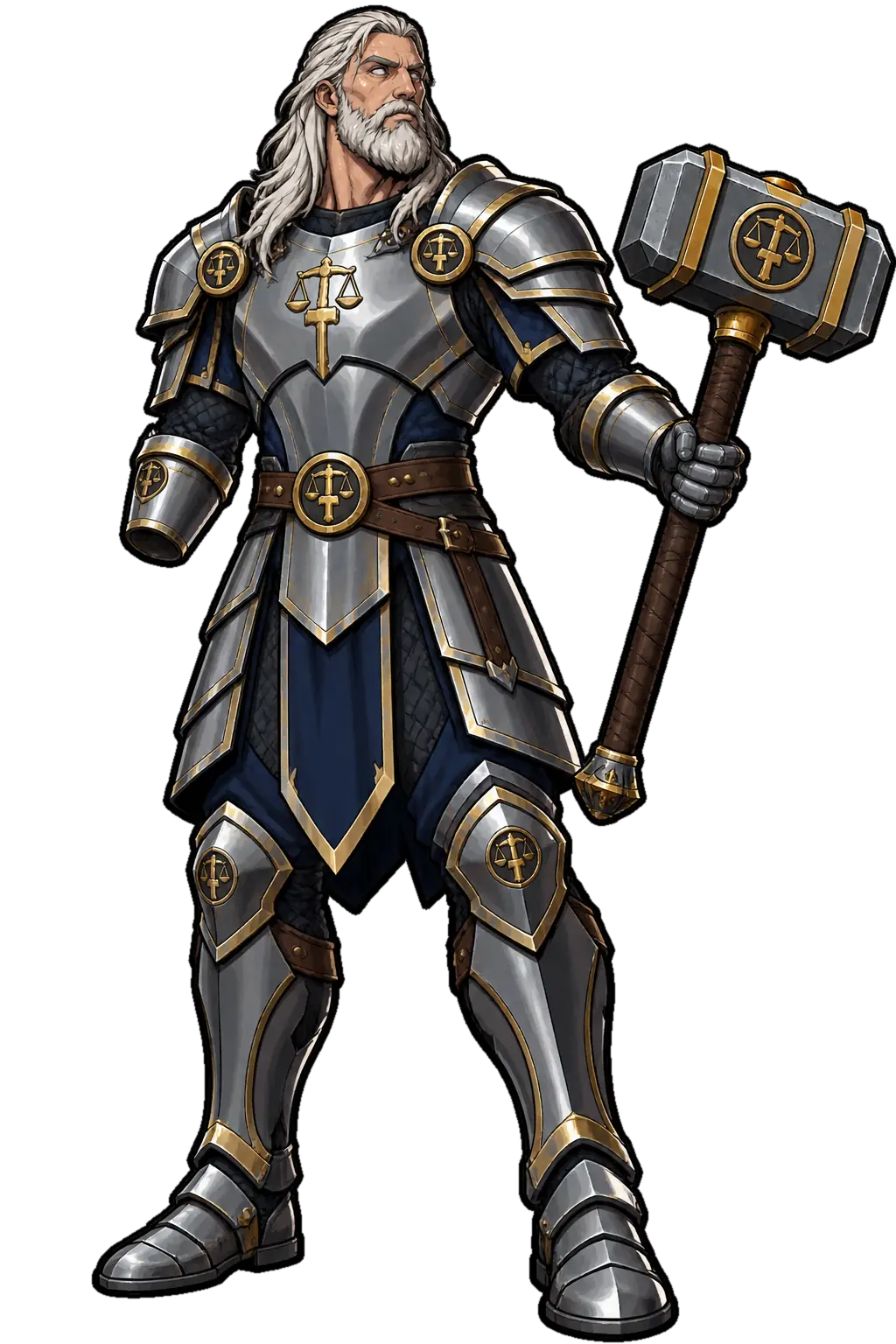
Tyr appears as a tall, muscular, mature warrior with pale blind eyes and a missing right hand. Steel plate carries restrained navy details and the mark of balanced scales resting above a warhammer.
He holds the Warhammer of Justice in his left hand. His head turns toward speakers with exact attention despite his blindness. False testimony makes metal ring without being struck, while a truthful confession causes every weapon nearby to lower by an inch.
Roleplaying the Avatar
Tyr is solemn, exact, and willing to delay judgment for relevant evidence. He has no patience for procedure used to conceal a predetermined result.
- Ask what rule applies to the judge.
- Separate proven facts from reasonable inference.
- State the remedy after stating the wrong.
- Allow confession to affect punishment without erasing harm.
- When deceived, name the lie and continue without anger.
Use in a Campaign
The Lawful Coup
A regent seizes power through technically valid decrees issued under coercion. Tyr asks the party to prove whether the law ever reflected lawful consent.
Judgment of Heroes
The party saved a city by sacrificing an unwilling district. Tyr convenes survivors, officials, and the characters to determine restitution.
The Missing Hand
A relic said to restore Tyr’s hand could also undo the sacrifice that binds a primordial enemy. Rival churches demand opposite judgments.
Trial of a God
A lesser deity violates a divine compact and invokes Tyr as judge. Mortal witnesses hold evidence the divine court cannot compel without destroying it.
Lairs
Tyr’s lairs expose concealment and preserve testimony. Spoken words remain audible, illusions cast contradictory shadows, and every restraint fits the creature whose conduct required it.
Hall of the Even Hand
A circular court gives accuser, accused, and judge equal height. Doors remain sealed until each party states the remedy it seeks.
The Blind Tribunal
No written record is visible inside this underground court, but every wall repeats testimony exactly when struck.
Field of the First Compact
Standing stones record oaths between rival peoples. A broken clause appears as a physical fracture in the responsible stone.
The Court of Justice
In Mount Celestia, petitioners cross bridges that support only those willing to be judged by the rule they invoke.
Shared References
Open a reference for its canonical description and related entries.